This blog describes some ideas that seem to be different from the current train of political thought. I will try to bring up somewhat unique and innovative ideas regarding political systems and policies in the US. I hope those who comment also bring in such ideas.

Showing posts with label Books. Show all posts

Wednesday, November 10, 2010

Just Finished Atlas Shrugged

What a monumental book. Whether you agree with her philosophy or not, you have to deal with it. The story is compelling, and the philosophy is logical. It really is a masterwork. I am now undecided as to whether Atlas Shrugged or Ulysses is the best novel of the 20th century.

Sunday, December 27, 2009

The Aeneid - by Virgil


I recently finished the epic story of Rome - Virgil's Aeneid. It tells the story of "Aeneas the True" as he flees from the fall of Troy, and starts the foundations of the Roman empire. To a certain extent it is propaganda, as the Greeks and Carthage are portrayed as enemies. It also is a reflection of the morality of the time. As Aeneas visits the underworld, traitors and tyrants are those singled out for punishments. The preaching of the greatness of Rome and of Caesar really does become tiresome.

But, also it is a outlining of an ideal of being true - both true as in honesty and true as in consistent, able, fixed, and immovable. Despite the antagonism of various deities and the vagaries of life, Aeneas stays true and fulfills his destiny. In some ways it shares the same hero outlook as Roark in the Fountainhead - a singular personage on a singular mission. However, it comes with a much stronger sense of morality and fate than is found in works by Rand, and much more akin to what is found in other classical literature such as the Bible. However, the telling of the epic journey can be seen to influence many other works, such as the Lord of the Rings and Gulliver's travels. Overall, it is an excellent piece of literature, a good glimpse into the psyche of Rome, and a valued foundational work, though not one I would read again.

Tuesday, November 24, 2009

Book Review: 1776


I just finished 1776 by David McCullough. It is very fascinating to read about this pivital year in United States History. The bravery, pluck, and perseverance of Washington and the Continental Army is truly inspiring. Their initial success at Boston was washed out by a disasterous New York campaign in which they exposed themselves to the British fleet, and were lucky to escape.

The losses led to a large number of desertions, and the near distruction of the army. However, after retreating across New Jersey, they end the year in splendid fashion with a gruelling but successful crossing of the Delaware in a blizzard, then winning the battle of Trenton. Their only losses of life were two people who froze to death on the march. Truly amazing.

It is commonly taught that the German soldiers stationed in Trenton were drunk, and thus the Continental Army had an easy time. However, McCullough points out that this was probably not the case, as the soldiers were quite disciplined, and he quotes historical records saying that they were not drunk. This makes their overwhelming victory even more impressive.

I recommend the book. For me, it is a well-told account of an amazing and world-changing twelve months.

Friday, November 13, 2009

Book Review - The Big Rich: The Rise and Fall of the Greatest Texas Oil Fortunes

Since the writer has written for the Wall Street Journal, I expected some good economic analysis in The Big Rich. Alas, it was not as potent an analysis as I would like. Instead, the author seemed to prefer to waste times on mocking their political beliefs, though never actually providing arguments for or against their beliefs. Thus, it was more of a distraction then a contribution.

The book was longer than it needed to be, especially since it could have used much more historical and economic analysis. The stories of risking it all and hitting a gusher are inspiring, as it is these types of people that make a big difference. However, it also shows how success can lead to their downfall, as after getting a fortune they risked it all again, and lost it. Even billionaires get in trouble by getting in more and more debt - something sensible governments should take to heart.

Tuesday, November 3, 2009

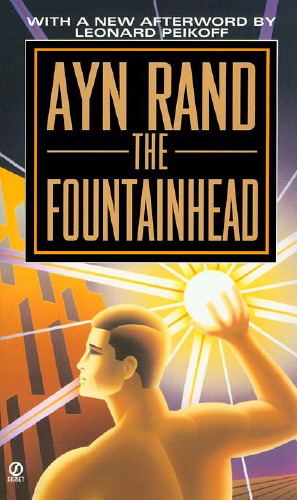
"The Fountainhead" by Ayn Rand


Now comes my delayed post of "The Fountainhead" by Ayn Rand. It is a rather thick novel, and to a certain extent more a book on philosophy than a story.

The characters are meant to exhibit principles. Thus, they can come across as fake. Howard Roark, the heroic architect, comes across to me as somewhat autistic. Dominic Francon, the herione, comes across to me as psychotic, with a more messed up "love-life" than a lampooning of the Jerry Springer show. Gail Wynand, the tough kid from NY who made good, but his fatal flaw of being a "second hander" leads to his downfall. Since I like good character development, it was a little frustrating.

The story is compelling. It has to be, or you would not get through the preaching. Roark working his way through low-level jobs, finally getting a chance to demonstrate his architectural genius, and then destroying a partially-built building when interlopers ruined it. A jury, practicing the lost art of jury nullification, acquits him.

The theme of the novel is that the producers, creators, designers, and builders are the highest manifestation of humanity. It reminds me of "quality" as discussed in "Zen and the art of motorcycle maintenance," as the book discusses architecture, quality building, and art. Ironically enough, both the undercurrent of quality and the undercurrent of psychotic characters.

Rand has been in the news recently, with a whole variety of people reporting on the new popularity, and even the new book reader from Barnes and Noble featuring the novel in publicity shots. I ended up reading The Fountainhead because it was on the shelf at Goodwill, I needed a novel for a trip, and I had never read Rand before. So, it had nothing to do with the current popularity of her work.

The Fountainhead is now quite popular in India, with an Ayn Rand-India blog. Judging from my Chinese friends, I am sure it will be quite popular there someday as well.

Tuesday, October 20, 2009

Joy at Work

I finished "Joy at Work" by Dennis W. Bakke recently. In it, he talks about how he built up his utility company by empowering employees and trying to create a "fun" workspace. His main definition of fun was one in which people would be able to be creative, and contribute in a meaningful way. He also stated that by cutting the staff at new plants in half, he was able to double productivity. It sounds like good advice for governments.

However, I don't really recommend the book. It seems like he is trying to do the same thing as Covey, but with a vastly inferior style. He has some good points and interesting stories, but it just doesn't seem to connect for me. Also, this book serves a mission that is rather common to CEO's that get booted: justifying their actions. He never seems to connect the fiscally prudent management strategy of eliminating debt with his removal. In the book he emphasized his Evangelical beliefs, so perhaps he should talk with Dave Ramsey, another public figure who emphasizes his Evangelical beliefs, about staying out of debt. It was debt that killed AES when the Enron fraud was discovered, and Bakke never seems to really admit it or believe it. It is all fun and games until you have to pay the piper - something governments should remember.

On other book notes, a lady I set next to on an airplane was reading "The Forgotten Man," which I reviewed a while ago. She was very excited about it as well. We talked about how the conditions leading to the great depression mirror the current economic and political climate. Here are another couple of blog articles discussing the book for you enjoyment, by Peter Galuszka and Pat Woodward. Longer discussions include an interview with author Amity Shales in Reason maganize from January, 2008, and a review from the Libertarian von Mises institute by C. J. Maloney.

I spent the flight reading "The Fountainhead" by Ayn Rand. I have now finished it, and I will discuss it in a later post.

Monday, August 31, 2009

Been moving, Bookseller of Kabul

I've been moving, so I haven't had internet access or the time to blog. Still, I took time to read "The Bookseller of Kabul" by Åsne Seierstad. It is fascinating to look at the recent history of Afghanistan, how people survive, and how families interrelate.

The "bookseller" was a rather notable man in Kabul, Shah Muhammad Rais. He has contested her version of events. It is interesting to look at both sides, especially as elections and conflicts rage on in Afghanistan.